


Interior Painting in Pelham, NY: Caring for Early-20th-Century Homes in a Commuter Village
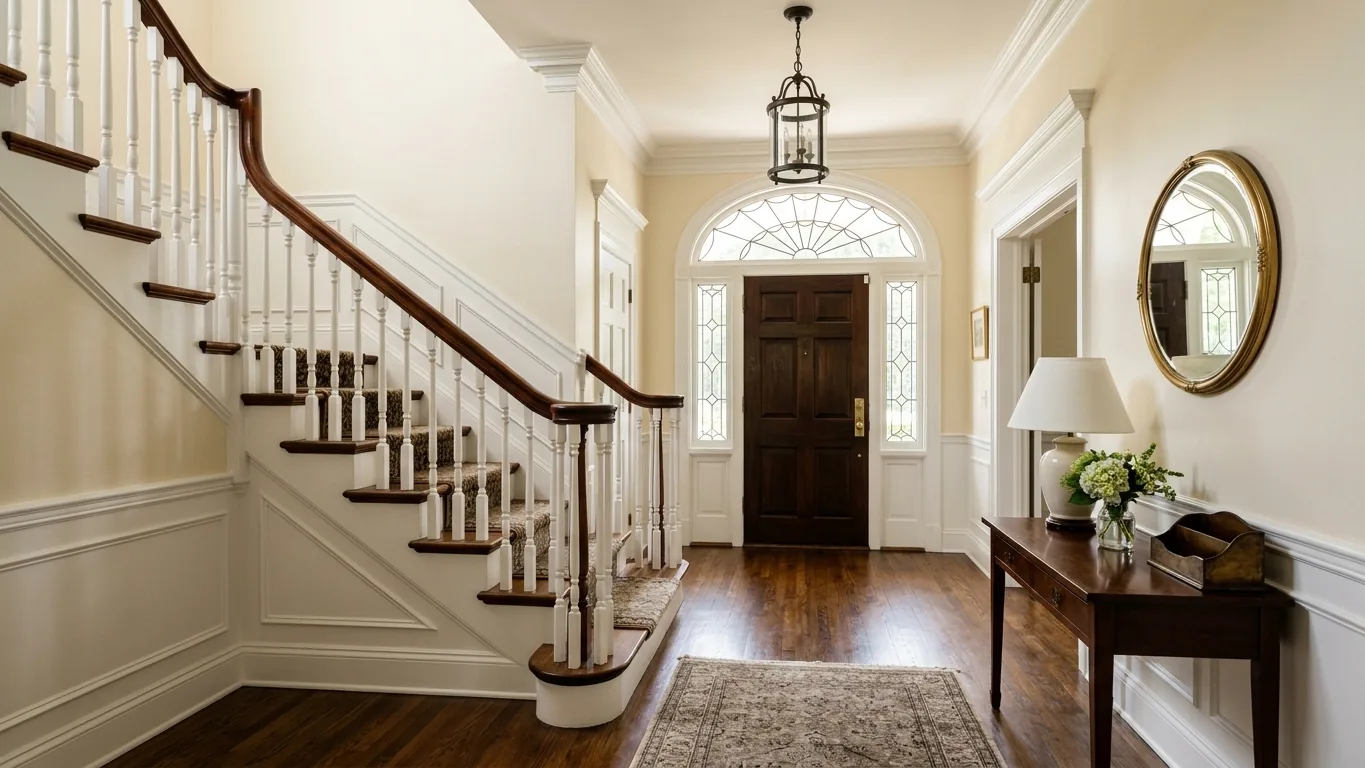
Pelham is a compact commuter village tucked between New Rochelle and Mount Vernon, and its housing stock reflects its history as one of Westchester’s original commuter communities. The streets of Pelham Manor, the village’s most prestigious section, are lined with Georgian Revival and Colonial Revival homes built between 1900 and 1930 for families who commuted to Manhattan by rail. Pelham proper has a more varied mix from the same era alongside mid-century construction. Throughout both villages the defining characteristic is well-built early-20th-century residential architecture with original plaster walls, generous moldings, and the layered paint history that comes from a century of continuous occupancy.
Interior painting in Pelham is primarily about caring for that stock, doing it properly, with the prep old plaster demands and the finish quality these homes deserve.
The Pelham Manor Interior Context
Pelham Manor’s Georgian Revival and Colonial Revival homes have interior proportions and detail that reflect serious architectural ambition. Formal entry halls with original staircase detail, dining rooms with chair rails and coffered ceilings, living rooms with elaborate crown molding, libraries with original built-in cabinetry. These are not interiors where a crew rolls through and sprays walls in two days.
The primary prep considerations here: original plaster carrying a century of paint layers, including oil-based layers that may not bond reliably with new latex without proper preparation; hairline cracks from a hundred years of seasonal movement; trim profiles painted over many times that need selective sanding to restore sharpness; and occasional water stains from long-repaired roof leaks that bleed through new paint unless sealed with shellac-based primer.
None of these are insurmountable. All of them require knowing what to do, which materials to use, and how long each step takes. A contractor who cannot read an old plaster wall before painting it will produce results that show those problems through the new finish.
Color Choices for Pelham’s Georgian and Colonial Revivals
The period architecture of Manor homes is best served by palettes that work with the architectural character rather than against it. That does not constrain you to historical colors. It means the colors you choose should have a tonal quality that complements the proportions and materials of the space.
For the formal rooms, entry halls, dining rooms, living rooms, warm off-whites, creams, soft greens, and muted blues have a long tradition that continues to look right. Benjamin Moore’s Historical Color collection has strong options, as does Farrow & Ball’s core palette. Farrow & Ball Pointing, Old White, and Mole’s Breath; Benjamin Moore White Dove, Pale Oak, and Hale Navy. These are not trendy choices, which is exactly what makes them right for rooms that should still look good in twenty years.
For the private rooms, bedrooms, studies, bathrooms, there is more latitude for personal expression. The constraint there is less about period appropriateness and more about the quality of the finish execution.
What Proper Prep Looks Like in Pelham Homes
In Manor homes, the prep sequence for a full interior project typically runs like this.
Surface assessment. Walking every room before work begins, identifying plaster cracks, water stains, failing adhesion on existing paint, glossy surfaces that will not hold new latex without dulling, and areas where previous patching used incompatible materials.
Crack repair. Hairline cracks filled with flexible joint compound, dried fully, sanded smooth. Larger cracks, or areas where plaster has separated from the lath, need more significant work: sometimes consolidation primer first, sometimes physical reattachment of the plaster section before filling.
Stain blocking. Water stains treated with shellac-based primer, typically Zinsser BIN, dried fully before any latex goes over them.
Surface dulling. Glossy existing enamel on trim and doors sanded or chemically de-glossed so new product can adhere.
Priming. A full primer coat on walls where significant prep was done, where the color change is dramatic, or where the existing surface requires it.
Only after all of that does topcoat go on. It is not a one-day process. It is the right process, and the results last accordingly.
Trim and Millwork: The Detail That Makes or Breaks a Pelham Interior
In Manor homes the interior trim and millwork, crown molding, chair rails, door casings, window aprons, built-in cabinetry, is often the defining quality element of the space. Fresh paint on the walls with tired, chipped, or yellowed trim reads as incomplete. The trim is what makes the walls look intentional.
Proper trim painting here requires patience. Doors need painting in a specific sequence, panels first, then stiles and rails, to avoid lap marks at the joints. Multi-piece crown assemblies need careful taping and cutting at each intersection. Window sashes and divided lights need steady hands and fine brushes. These are not tasks for a roller crew working on speed.
We address trim as a distinct phase of every Manor interior project, never as an afterthought rolled on with the same sequence as the walls. It is assessed separately, prepared appropriately, and finished with the product and attention it deserves.
Pelham’s Mid-Century and Village Housing
Pelham proper, outside the Manor, has a mix of mid-century Colonials, Cape Cods, and post-war construction alongside the older stock. Surface conditions vary more here: some homes have original plaster like the Manor, others have been renovated and have drywall, and many have both as rooms were updated at different points.
The prep requirements vary correspondingly. We assess each space individually rather than assuming all walls get the same treatment. A newly renovated kitchen with fresh drywall and a hundred-year-old plaster living room in the same house need different primer, a different prep sequence, and potentially different topcoat product.
What Drives the Estimate
Interior painting in Pelham varies with the house more than with the square footage. What moves the number:
Surface condition. The single biggest factor. Sound drywall is quick. Century-old plaster with crack repair, stain blocking, and oil-to-latex transition work is a different job.
Trim and millwork volume. Elaborate crown, chair rails, built-ins, and divided-light sash are hand work, and hand work takes the time it takes.
Room count and ceiling height. Manor formal rooms need staging that a village Cape does not.
Color change. A dramatic shift means an extra coat, sometimes a full primer coat first.
Product specification. Farrow & Ball, Benjamin Moore Historical, and standard lines are different materials at different costs.
Every project receives an itemised estimate before work begins, after we have walked the rooms and seen the actual conditions.
Frequently Asked Questions
How long does interior painting take in a Pelham Manor home?
A Manor home with formal rooms, original plaster, and significant architectural detail typically takes 10 to 16 business days for a full interior project. The prep work, crack repair, stain blocking, trim preparation, adds time compared to newer construction. We provide a project-specific timeline after assessing the actual surface conditions.
What does interior painting cost in Pelham?
It depends on the size of the home, the surface conditions, the volume of trim and millwork, the extent of color change, and the product specified. Manor homes with significant plaster repair and trim preparation involve considerably more prep than a village Cape. Every project receives an itemised estimate before work begins. Call 1 (800) 687-9470 or visit palette-pro.com.
How do you handle oil-based existing paint on old Pelham plaster?
Old oil-based paint on plaster can be a bonding challenge for new latex. We assess the existing finish for adhesion quality and, where needed, either sand to dull the old oil finish or apply a bonding primer designed to bridge between old oil-based and new water-based products. We do not skip this step on old plaster with an oil-based paint history.
What primer do you use on Pelham Manor plaster walls?
It depends on the surface. Sound plaster in good condition takes a PVA or bonding primer. Water stains take shellac-based primer before any topcoat. Soft or powdery plaster takes a penetrating consolidator primer. Areas with intact oil-based paint that need to accept new latex take a bonding primer formulated for that transition.
What paint brands do you use for Pelham interiors?
Benjamin Moore, Sherwin-Williams, and Farrow & Ball. Farrow & Ball’s heritage palette suits Manor Georgian and Colonial Revival interiors particularly well. Benjamin Moore’s Historical Color collection and Aura line are also strong options for these homes.
Do you serve both Pelham Manor and Pelham village?
Yes. We work throughout both Pelham villages, Manor, Pelham, and North Pelham, as well as the surrounding areas including New Rochelle, Mount Vernon, and Larchmont.
Ready to refresh your Pelham home? Palette Pro Painting & Renovation has earned 140+ five-star Google reviews from homeowners across Westchester and Fairfield counties. Call 1 (800) 687-9470 for a free estimate, or visit palette-pro.com.
Related reading
- how we approach Mount Vernon interior painting
- a neighborhood guide to New Rochelle interiors
- painting pre-war Bronxville apartments and Tudor homes
- the full range of services we offer
