


How Should Built-Ins and Crown Molding Be Painted?
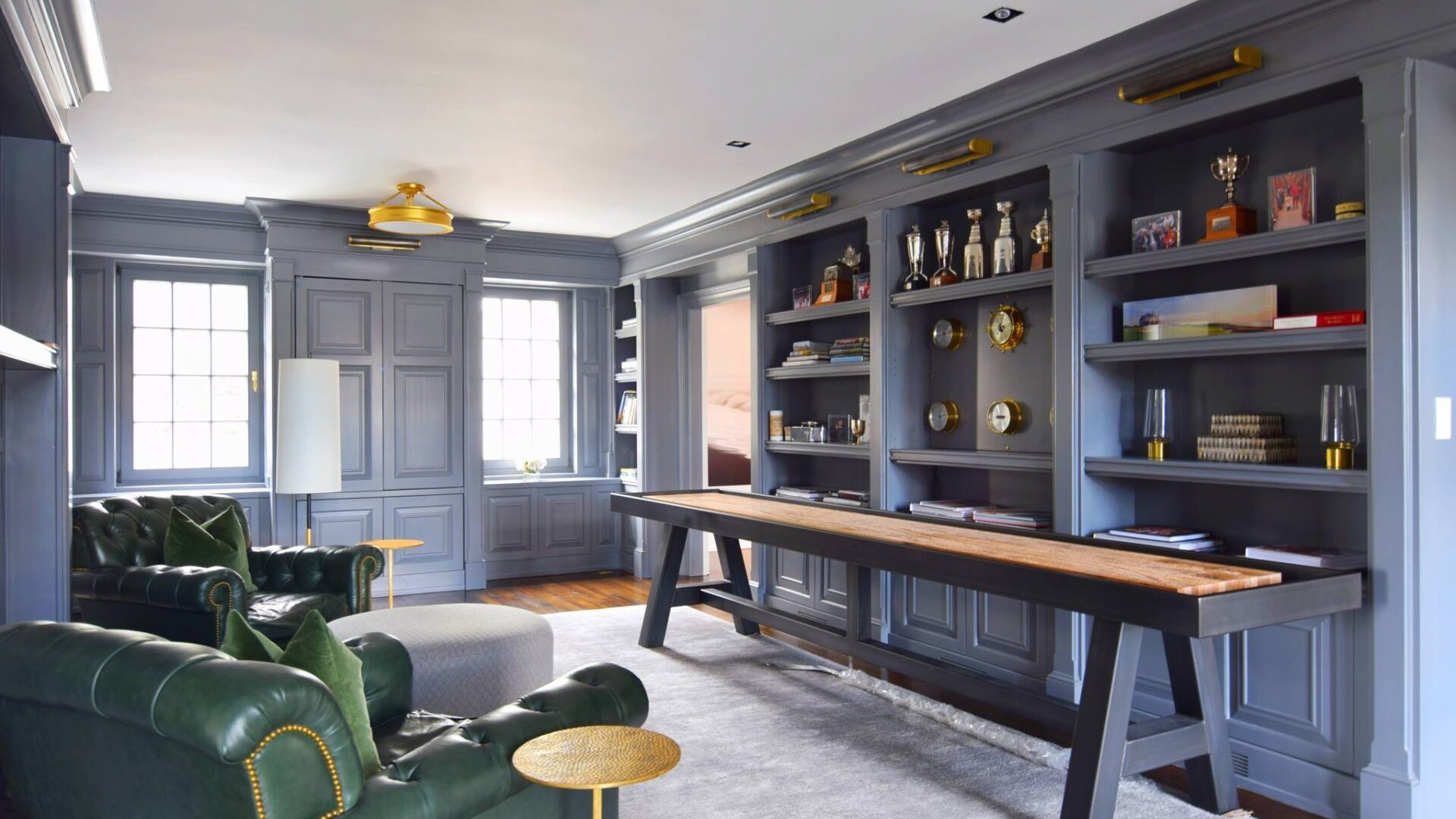
Built-ins and crown molding should be painted in enamel one or two steps glossier than the walls, usually satin or semi-gloss, after the joints are caulked and the nail holes filled and sanded flush. Crown gets a clean cut line where it meets wall and ceiling, and built-ins get the cabinet treatment: de-gloss, then bonding primer.
Houses in Armonk are young by local standards, and a lot of their character lives in the trim. The hamlet’s median home was built in 1982, per the U.S. Census Bureau’s American Community Survey for 2019 to 2023. Nearly a third, 31%, went up in 2000 or later, and 93% are owner-occupied.
Many of those houses were built with heavy trim: deep crown, coffered ceilings, paneled walls and built-in bookcases on either side of the fireplace. In rooms like that, a wavy line on the crown reads as damage to the house.
When we paint trim in Armonk, out in Banksville or up in Bedford, the millwork can take more of the schedule than the walls do.
What sheen should crown molding and built-ins have?
Crown molding and built-ins look and wear best in satin or semi-gloss enamel. Enamel cures harder than wall paint, so it stands up to hands and to the vacuum knocking into the baseboard. A little extra sheen also makes each profile on the crown read crisply against a flatter wall.
Semi-gloss is tougher and wipes clean more easily, but it shows every dent and seam. Satin is kinder to older, dinged trim and still cleans up well. High gloss gives a lacquered look to a library of built-ins, though it demands near-perfect prep because it hides nothing.
On our interior painting jobs, the sheen gets chosen with the color, before anyone climbs a ladder.
How do you prep crown molding and built-ins for paint?
Prep on crown molding and built-ins runs in a set order, and it takes longer than the painting itself. Here’s the sequence we follow:
- Empty and take apart. Shelves get cleared and adjustable shelves come out. Doors come off and get labeled with their hinges, so each one goes back where it came from.
- Protect the room. Floors and furniture get covered, and an air scrubber runs while we sand so the dust stays in the room we’re working in.
- Clean. Built-ins near a kitchen or a fireplace collect grease and soot, and paint won’t bond to either one.
- Fill and sand. Nail holes and open miters get filled and sanded flush, so the joints disappear under the enamel.
- Caulk the seams. A thin bead of paintable caulk closes the gap where crown meets wall and ceiling, and where a built-in meets the wall.
- De-gloss and prime. Previously finished built-ins get de-glossed or scuff-sanded, then a bonding primer, the same steps we use on kitchen cabinets.
- Enamel last. Finish coats go on after everything else is done, with the crown cut cleanly against the wall and ceiling colors.
Tall rooms change the logistics. Crown in a two-story family room means staging instead of a stepladder. We plan for it at the pre-production meeting so day one starts on time.
Should crown molding match the walls or the ceiling?
Crown molding usually matches the rest of the trim, which ties it to the door casings and baseboards and frames the room. Painting it the ceiling color softens the line and can make a lower room feel taller. Matching the wall color is the quieter, more modern choice, and it lets the shadows in the profile do the work.
Any of those can be right, as long as it’s settled before we put you on the schedule. A crown color that changes after the walls are cut in means re-cutting every line in the room.
If a designer is choosing colors, ask for a drawdown: the trim color in its actual sheen, approved in the room’s own light.
Call 1 (800) 687-9470 to have us look at your trim and built-ins before the colors are final. The in-home consultation is free.
When does trim need a carpenter before a painter?
Trim needs a carpenter first when the problem is the wood itself. That means a split miter, a missing return on the crown or a cracked rail on a built-in. Paint over any of those and the flaw just gets glossier.
Because Palette Pro Painting & Renovation keeps painting and renovation under one roof, our carpenters fix the wood and our painters finish it on the same schedule. When customers write about our trim work, they tend to mention the carpentry and the paint together.
New millwork works the same way. Our Custom Millwork projects start from shop drawings and move through fabrication and installation, and the finishing is ours too.
We love the day the books go back on the shelves. A bookcase that looked like furniture suddenly reads as part of the house. There’s more of that work in our custom millwork portfolio.
Not every built-in should be painted, though. Quarter-sawn oak or walnut with its original finish in good shape is usually better cleaned and refreshed. Paint on open-grain wood is close to permanent.
Frequently Asked Questions
What kind of paint do you use on crown molding?
Crown molding gets a premium interior enamel in satin or semi-gloss, the same family of paint that goes on doors and casings. Waterborne enamels level out smooth, dry harder than wall paint and don’t yellow the way traditional oil-based enamel can over time.
On older trim, a bonding or stain-blocking primer goes on first when the existing finish calls for it.
Can you paint stained built-ins without stripping them?
Stained built-ins can be painted without stripping as long as the existing finish is sound. We clean them, de-gloss or scuff-sand the old finish and apply a bonding primer, which gives the enamel something to grip on a slick, varnished surface.
Oak has open grain that shows through paint, so ask about grain filling if you want a smooth, furniture-like face. Some woods also bleed tannins, and a stain-blocking primer keeps them from yellowing the new color.
How soon can books go back on painted shelves?
Books can go back on painted shelves once the enamel has cured, and curing takes longer than drying. Fresh enamel can feel dry long before it’s hard. Until then, a book cover can stick to the shelf and pull paint with it, which painters call blocking.
The coating’s label gives the cure time. We’ll go over it with you at the walk-through, before you start loading shelves.
Is crown molding out of style?
Crown molding isn’t out of style in houses designed around it, and many Armonk houses were. In a room with coffered ceilings and built-ins, crown is part of the architecture. Taking it down tends to leave the ceiling line looking unfinished.
What’s changed is the profile, since newer builds lean toward simpler, flatter crown, often painted to match the ceiling.
Why do the corners of painted crown molding crack?
Painted crown cracks at the corners because wood swells and shrinks as the air indoors gets drier or damper through the year. A miter joint is where that movement shows first. Filled and caulked joints keep the line tight for longer.
No paint stops wood from moving, though. If a corner keeps opening, the fix is carpentry first and paint second.
Start with the room whose trim bothers you most. We’ve been at this since 2009, with painting and renovation under one roof, so a split miter and its fresh enamel are one job instead of two. We work in homes across Westchester County, NY and Fairfield County, CT. Call 1 (800) 687-9470 for a free in-home consultation.
