


Cabinet Refinishing in Greenwich, CT: A Smarter Kitchen Upgrade for High-End Homes
Greenwich kitchen decisions involve different math than most markets. The kitchens here are often large, with high-end bones already in place: solid wood cabinet boxes, granite or marble countertops, professional-grade appliances. The question is rarely whether to renovate. The question is what actually needs to change.
For many Greenwich homeowners, the answer is the cabinet finish, not the cabinet itself. Dark cherry from 2004, glazed maple from 2010, or a yellowed painted finish from a previous owner: these are cosmetic problems with a cosmetic solution. Cabinet refinishing, done at the quality level Greenwich homes require, delivers results that are visually indistinguishable from new custom cabinetry while leaving the cabinetry you already own in place.
This guide covers who cabinet refinishing is right for in Greenwich, what the process involves at a high-end execution level, and what actually drives the estimate.
The Greenwich Kitchen Context
Greenwich kitchens differ from Westchester kitchens in ways that affect the refinishing conversation. Cabinet boxes in Greenwich’s premium homes, particularly in the Backcountry, Cos Cob, and Old Greenwich sections, are typically solid wood or high-quality plywood, not the particle board or MDF found in entry-level cabinetry. Door styles tend toward raised panel, inset, or shaker profiles with substantial detail. The hardware is often high-end, sometimes worth retaining rather than replacing.
The implication is that the bones of these kitchens are genuinely worth preserving. The investment in solid construction, quality hinges, and a well-designed layout does not need to be discarded to update the look. Refinishing the finish surface while retaining the boxes, hardware, and layout is not a compromise. It is the right answer when the structure is sound.
Who Is the Right Candidate for Cabinet Refinishing
Cabinet refinishing makes sense for Greenwich homes whose cabinets meet a few criteria. The box, the structural frame fixed to the wall, needs to be in good condition. Refinishing addresses the finish surface, not structural integrity. Warped boxes, water damage under the sink, or failing hinges that cannot be tightened are repair or replacement issues.
The door style needs to be one you are keeping. Refinishing changes color and finish but not the door profile. If the goal involves moving from a raised panel to a shaker style, the doors need to be replaced, though the boxes can be retained and the new doors finished before installation.
The cabinet material needs to be paint-receptive. Solid wood and MDF doors refinish to a factory-quality surface with proper prep and application. Thermofoil or laminate doors that are delaminating are poor candidates without specific surface treatment.
What High-End Cabinet Refinishing Involves
At the quality level Greenwich homes require, refinishing is a precision process. The difference between acceptable and exceptional is application method and product selection.
Doors and drawer fronts come off and get labelled. Hardware comes off. The cabinet boxes are cleaned, degreased, lightly abraded, and primed in place, with careful protection of countertops, flooring, and appliances during the spray and dry phases.
Doors and drawer fronts move to a controlled spray environment with dust control and appropriate ventilation, where they are cleaned, degreased, abraded, and primed with a bonding primer suited to the substrate. Finish coats go on by HVLP spray in thin, even passes. The result is a surface free of the brush marks and roller texture that define lower-quality refinishing work.
Product selection matters as much as application. For Greenwich kitchens we typically specify a catalysed conversion varnish or a high-quality waterborne acrylic formulated for cabinetry, not standard interior wall paint applied to cabinet surfaces. Cabinetry finishes dry harder, resist chipping and blocking, and hold up under the daily cleaning that kitchen surfaces receive.
Color Directions for Greenwich Kitchens
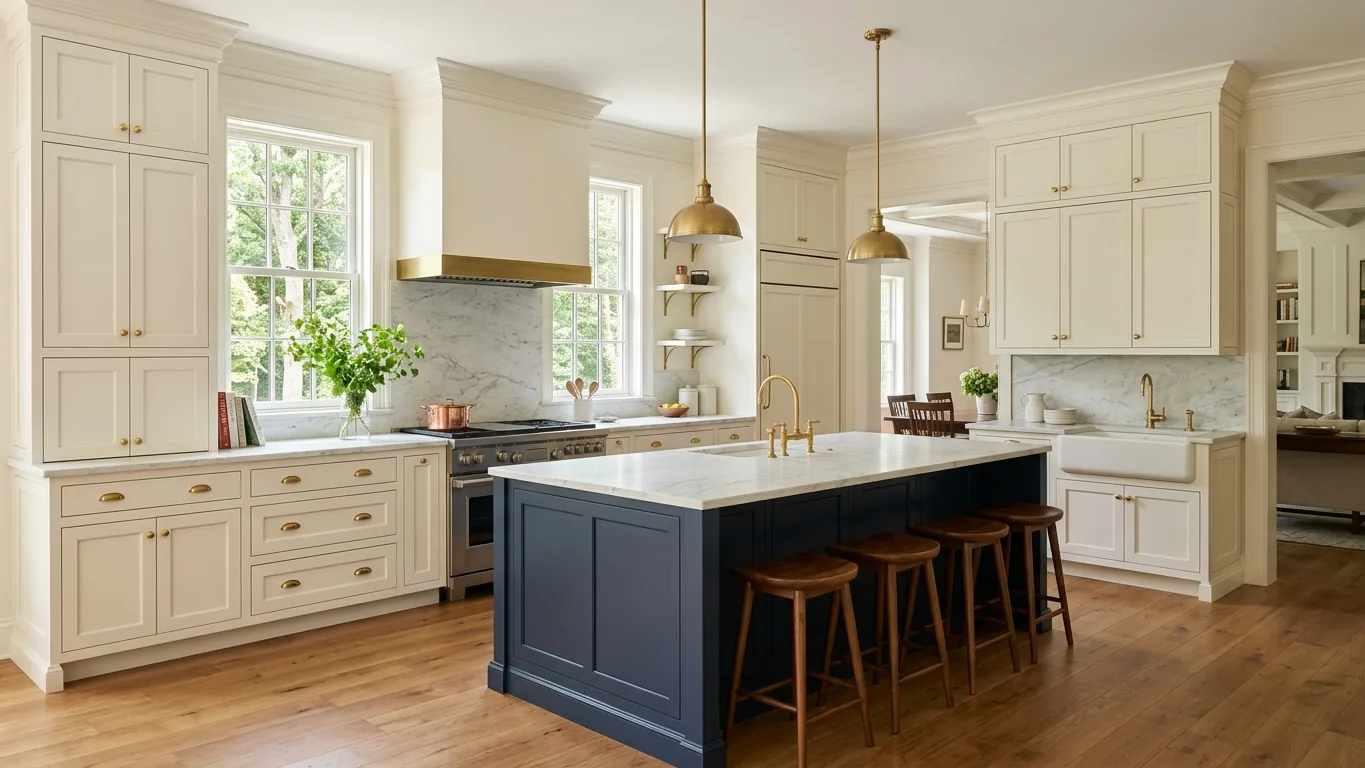
The color trajectory in Greenwich kitchens has moved strongly toward white and off-white over the past decade, with a significant segment choosing soft greens, blues, and warm greys, either for the full kitchen or for the island and lower cabinets in a two-tone approach.
Benjamin Moore Simply White and White Dove dominate the white end. Farrow & Ball Pointing and All White suit clients who want a white with more depth. For color, Benjamin Moore Hale Navy and Van Deusen Blue on islands are perennial choices here. Farrow & Ball Mizzle, a complex sage, appears regularly in kitchens that want something distinctive without being trendy. Sherwin-Williams Accessible Beige and Agreeable Gray serve homeowners who want warmth without committing to color.
Two-tone kitchens suit the large, open-plan kitchens common in Greenwich homes. The visual separation adds definition to a large space, and the island becomes a design anchor.
What Drives the Estimate
Homeowners want a number before we have seen the kitchen, and the honest answer is that a real number comes from the walk-through. What moves it:
Door and drawer count. This is the single biggest driver. A galley kitchen with 18 doors is a different job from an L-shaped kitchen with an island and 50 doors and drawer fronts. Every one of them comes off, gets prepped, gets sprayed, and goes back on.
Condition of the existing finish. An intact factory lacquer preps quickly. A surface that has already been painted once, badly, has to come back to something sound. Laminate needs scuffing and a bonding primer that solid wood does not.
Product specified. A catalysed conversion varnish and a cabinetry-grade waterborne acrylic are different materials with different costs and different working properties.
Scope beyond the kitchen. Butler’s pantries, wet bars, mudrooms, and laundry cabinetry are often installed at the same time as the kitchen and look just as dated. Including them adds scope but not proportional effort, because the setup, spray equipment, and dry time are already established.
Hardware. Removing and reinstalling existing hardware is part of the job. Sourcing and installing new hardware is a separate line.
What refinishing does not include is the part that makes replacement expensive: new cabinetry, demolition, installation labor, and the countertop work that comes with it. That is the real difference between the two paths, and it is a difference in scope rather than a discount.
How to Evaluate Refinishing Proposals
When comparing proposals, the key question is not the price but what the scope includes. A proposal that specifies spray application with a catalysed product is fundamentally different from one that describes two coats of paint on cabinet doors. The first is a cabinet-quality finish process. The second is a brush-and-roll paint job on cabinet surfaces, and the results will look and perform accordingly.
Ask every contractor you are evaluating: are doors removed or painted in place? What application method? What specific product line, and is it formulated for cabinetry or a standard interior line? Those answers tell you more about what you are buying than the price does.
Frequently Asked Questions
How long does cabinet refinishing take in a Greenwich kitchen?
A typical Greenwich kitchen with 35 to 55 door and drawer fronts takes 5 to 10 business days from door removal through reinstallation, including all prep, primer, finish coats with appropriate cure time between coats, and final inspection. Larger kitchens with more complex detail or butler’s pantry scope run toward the longer end. We provide a specific timeline at the estimate visit.
Can refinished cabinets match new custom cabinetry in finish quality?
With spray application and a product formulated for cabinetry, yes. The distinguishing factor is application method. Brush-and-roll produces a textured surface that reads as painted. Spray application produces a smooth, even surface that reads as factory-finished.
What does cabinet refinishing cost in Greenwich?
What it comes to depends on the number of door and drawer fronts, the condition of the existing finish, the product specified, whether secondary cabinetry is in scope, and whether hardware replacement is included. Every project receives a detailed, itemised estimate before work begins. Call 1 (800) 687-9470 or visit palette-pro.com to schedule your free estimate.
What products do you use for Greenwich cabinet refinishing?
We typically specify a catalysed conversion varnish or a high-quality waterborne acrylic formulated for cabinetry, products that dry harder, resist chipping, and hold up under the cleaning that kitchen surfaces receive. We do not use standard interior wall paint on cabinet surfaces. We can match specific Farrow & Ball, Benjamin Moore, or custom color specifications.
Can you refinish just the island cabinets?
Yes. Refinishing just the island, or just the uppers, or any defined section is entirely possible. We provide per-section estimates so you can make a clear decision about scope. Many Greenwich homeowners refinish the full kitchen first and return for butler’s pantry or laundry cabinetry separately.
How do refinished cabinets hold up in a high-use kitchen?
With the right product and application method, refinished cabinets are durable under normal high-use conditions. The key is product selection: a catalysed conversion varnish or a cabinetry-specific waterborne acrylic dries harder and resists chipping far better than standard interior paint applied to cabinet surfaces.
Ready to update your Greenwich kitchen without a full renovation? Palette Pro Painting & Renovation has earned 140+ five-star Google reviews from homeowners across Westchester and Fairfield counties. Call 1 (800) 687-9470 for a free estimate, or visit palette-pro.com.
Related reading
- cabinet refinishing for Scarsdale kitchens
- how long cabinet painting actually takes
- refined interior finishes for Greenwich homes
- painting and renovation in Greenwich, CT
